Albania
 Argentina
 Australia
 Austria
 Belgium
 Bosnia and Herzegovina
 Brazil
 Bulgaria
 Canada
 Chile
 Colombia
 Croatia
 Czech Republic
 Denmark
 Estonia
 Finland
 France
 Germany
 Greece
 Hungary
 Ireland
 Italy
 Latvia
 Lithuania
 Luxembourg
 Mexico
 Moldova
 Montenegro
 Netherlands
 New Zealand
 North Macedonia
 Norway
 Philippines
 Poland
 Portugal
 Romania
 Serbia
 Slovakia
 Slovenia
 South Africa
 Spain
 Sweden
 Switzerland
 Turkey
 Ukraine
 United Kingdom
 United States of America



Telescopis speaker poles
A telescopic speaker pole positions a loudspeaker or satellite above a stand or subwoofer so it does not remain near the floor and sound can disperse from a more suitable height. You can adapt the adjustable length to the stage, room and setup, but always within the manufacturer’s limits. When choosing, compare the mounting diameter, minimum and maximum length, load capacity, thread and locking method. The pole is only a connecting element, so the safety of the result also depends on the base, loudspeaker weight and correct installation.
Stand, subwoofer and connection method
The pole can be inserted into the socket of a stand or mounted on a subwoofer. A common insertion mount has a diameter of 35 mm, but you need to verify this value at both ends of the setup. M20 occurs with threaded connections; the thread prevents the pole from being unintentionally pulled out, but it is not interchangeable with an insertion socket. If the mounting does not fit, look for a suitable adapter among parts intended for that combination, not an improvised modification.
When you also need a base, look at telescopic speaker stands or the broader range of loudspeaker stands. A pole on a subwoofer saves space compared with a separate stand, but transfers the weight of the top loudspeaker to the cabinet and its thread or socket. Confirm that the specific subwoofer is intended for such mounting before use.
Comparison of mounting methods
| Design | Where it connects | What to check | Practical note |
|---|---|---|---|
| Insertion pole | Socket of a stand or subwoofer | Diameter and insertion depth | The safety lock must prevent unwanted movement |
| Pole with M20 thread | Matching thread on the subwoofer | Exact type and undamaged thread | Screw the pole in straight, without force |
| Pole with adapter | Setup with different diameters | Compatibility and load capacity of every part | More joints require more thorough inspection |
| Telescopic pole with crank or lifting assistance | According to the model’s socket or thread | Lifting and locking procedure | The mechanism does not replace compliance with load capacity |
Length, load capacity and headroom
Read the length range together with the recommended load. The top loudspeaker must remain below the limit of the pole and also below the limits of the socket, subwoofer or stand; the final load capacity is determined by the weakest link. Headroom above the actual weight is more sensible than operating precisely at the limit. Extending the pole changes the leverage acting on the base, so maximum height may not be the best working position.
The loudspeaker should be high enough that its coverage is not blocked by the front rows, not automatically as high as possible. Consider floor slope, stage height and audience position. If you use two loudspeakers, set them to a comparable height and check the stability of both sides separately. Uneven ground or a soft surface requires changing placement, not shimming with random objects.
Locking is not a minor detail
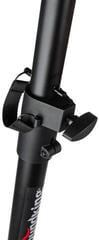
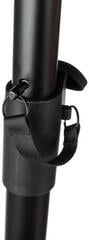
Height may be held by a screw, clamp and safety pin, or a combination of elements. The pin belongs in the designated hole and the main clamp is tightened according to the instructions. If the mechanism slips, do not use tape or excessive tightening; remove the pole from service and inspect it. After installation, gently check that the inner section does not rotate or slide down.
Safe working procedure
- Inspect the pole, thread, sockets, safety locks and the complete base without load.
- Place the base on a firm, level surface and leave free space around it.
- Attach the pole at its lowest position and secure it with the designated mechanism.
- Mount a heavier loudspeaker with two people or use an intended lifting aid.
- Adjust height gradually, secure all locks and check stability before connecting cables.
Route the cable so no one can catch or pull on the top part of the setup. In areas used by the audience, consider physically separating the stand from the walkway. Outdoors, account for wind and changing ground conditions; guidance on safe use in specific conditions must come from the manufacturer or responsible technician. Use stand ballast only in the manner for which it is intended.
Material, weight and transport
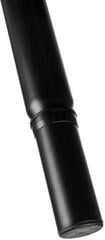
Steel and aluminium designs differ in weight, rigidity and behaviour during long-term use. Do not assess material in isolation: construction of the walls, locks and threads matters. Lower weight can be pleasant for a mobile setup, but with frequent assembly you will also appreciate clearly readable adjustment and parts that are easy to inspect. Transport the pole retracted and locked so the inner section cannot extend on its own.
- Remove detachable adapters before travel and store them so they cannot be lost.
- Protect the thread against impact and dirt.
- After use in damp conditions, dry the pole and inspect the places where sections slide into one another.
- Inspect pins and screws regularly; replace damaged parts with designated components.
- Do not carry the pole with a loudspeaker mounted on it.
Selection for a real setup
Write down the model and weight of the top loudspeaker, the type of lower socket, required working height and transport method. Then compare these details with the pole documentation. Brands such as Revoltage, Soundking, Gravity, Gator Frameworks, Bespeco and Avante may use different mounting systems; the manufacturer’s name alone does not confirm compatibility. The dimensions and permitted use of the specific product are decisive.
If you build the setup from several parts, inspect every connection separately. Loudspeakers with a clearly stated socket type and weight may also be useful for the complete system. Before the first event, assemble the setup in a safe space, set the intended height and practise assembly and disassembly without time pressure.
What to avoid
Do not insert a narrower pole into a wider socket without a designated adapter and do not alter the diameter by wrapping material around it. Do not exceed the load capacity, combine unidentified threads, or leave the safety pin outside its hole just because the clamp appears to hold. Do not use equipment with a damaged thread or bent pole. Small play becomes more pronounced under load and when extended.
A telescopic pole must first of all fit dimensionally and support the specific setup under conditions specified by the manufacturer. Its adjustability then lets you adapt the height for a smaller event or mobile sound system. Check the diameter or M20 thread, length, load capacity and lock. Then assess stability across the entire setup, not from the pole alone.